Inspirational!
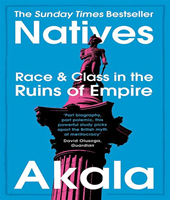
Natives offers through Akala’s experiences an insight into the lives of many Afro-Caribbean men and perhaps women who can identify themselves to the hazards of life in England particularly in the capital from the 80s onward.
The themes addressed in this opus such as education open a valve to pour ideas on the reality of institutionalized racism in schools. Critical race theorist David Gillborn argues that schools as an institution do not favour the education achievement of British pupils of Afro-Caribbean origin due to the mechanisms of racism that Akala and many other British pupils of similar origins have experienced. One very interesting example of Akala’s experience at school that can assess the extent of racism in education is how he questioned the impact of William Wilberforce on the processes that have led to the end of slavery and how the curriculum still maintains an ethnocentric approach to teach a major event in world history. Has William Wilberforce ‘by himself’ ended slave trade in England?
Another theme addressed is thus naturally identity. The symbolisms attached to Great Britain, are often of power, imperialism or the Union Jack, despite a rich history of struggles against the idea that only a few could identify themselves to the symbols of power. Such symbolisms seem to have created cracks on a desired identity. How complicated it becomes to define its own identity when the entire nation is not represented. Paul Guilroy illustrates this idea of a volatile identity when he makes the inquiry about the absence of the color black on the Union Jack. Akala on the other hand refers to Linford Christie and the black excellence in sport that has not been relayed in the media despite his victory at the 1992 Barcelona Olympics and the pride of carrying an esteemed flag. He did not identify himself to the Jamaican flag despite being born there, nor to the Pan African flag but to the imperialist Union Jack. Yet, Akala explains that the media used their secondary socializing power to disconnect Linford Christie from his chosen identity to instead assert their stereotypical understanding of a black athlete.
The inevitable experience of being searched by the police was explained by Akala as the norm and the way he dealt with his first encounter was as if he had been given the ‘talk’, not about intimacy with your life long partner but about safety when dealing with your life long protector in black and white if you live in the UK. But despite the wise advises of his teacher on how to exercise his rights when facing what could be considered as a threat, the police had too much power for the young teenager he was at the time. It was interesting to see that despite his shift in social class, his relationship with the police remained the same.
There are many themes discussed in Natives such as crime, politics that you will find insightful even surprising but to finalize, how bizarre that the interactions between two distinctive ethnic groups have created a moral panic about their very own existence. Akala reveals that the idea of supremacy is not sustainable. The invasion of Kemet demonstrated that the gods ruling the land had limitations. Furthermore, the Haitian Revolution, the victory of Jesse Owens or the rise of China’s economic power prove that white supremacy is not factual. This truth may have developed a fear especially among westerners as Akala points out who were psychologically accustomed to the idea of supremacy. So, why one ethnic group cannot hold its political and cultural supremacy for as long as they wish?